Policemen cast their votes ahead of 18th Lok Sabha elections in Tamil Nadu
| Photo Credit: JOTHI RAMALINGAM B
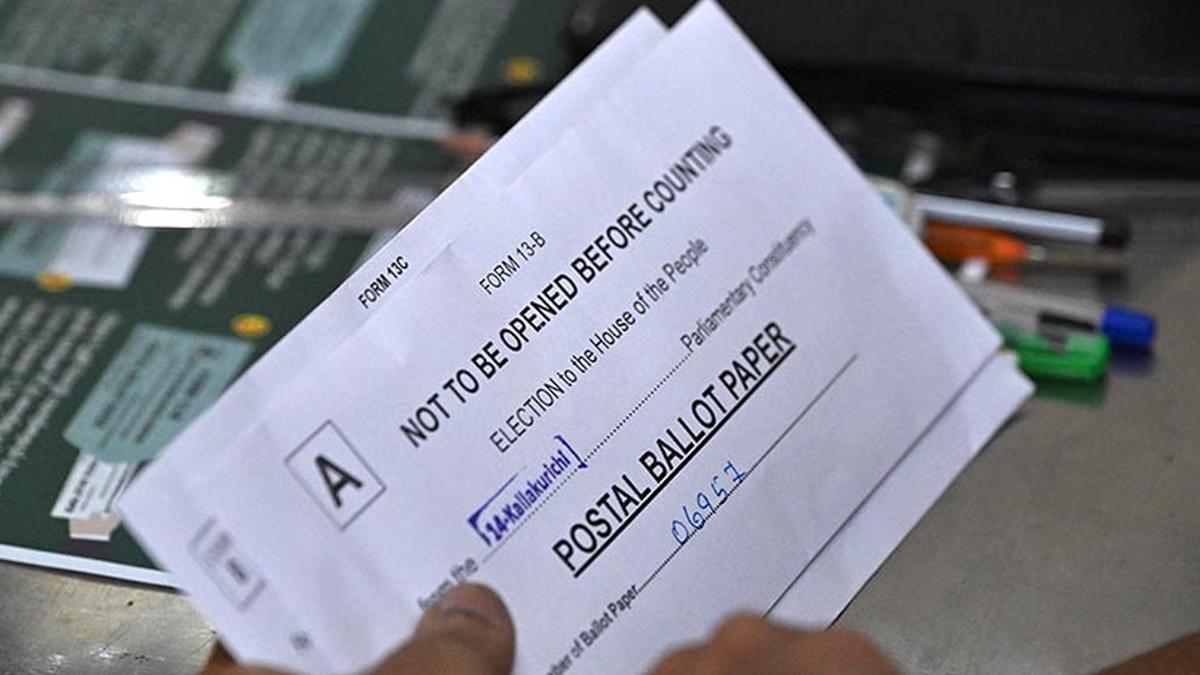
The Election Commission (EC) allows postal ballots for certain sections of voters, including government employees who are on poll duty, those who are serving in the armed forces, elders aged 85 years or above and persons with disabilities. Among these groups, it is government employees who exercise their franchise through postal votes the most.
Postal votes account for only a miniscule percentage of the total votes cast in the elections. However, it serves as a useful proxy to understand how the people who are part of the ruling establishment, that is, the government employees voted in the elections. Consequently, it can also serve as an indicator to gauge the anti-incumbency sentiment against the ruling party among the State’s administrative workforce.
An analysis of the recently concluded Assembly elections in the States of West Bengal, Tamil Nadu, Kerala, Assam and the Union Territory (UT) of Puducherry reveal certain interesting patterns. Of these, the incumbent governments were voted out in West Bengal, Tamil Nadu and Kerala, while they were retained in the other two.

In the three States where the ruling parties lost the elections, their vote share among postal votes came down compared to their performance in 2021. This was true in Puducherry as well even though the All India N.R. Congress (AINRC)-led National Democratic Alliance returned to power in the U.T. Assam was the only place where the ruling BJP saw a noticeable increase in its vote share among those who used postal ballots.
The Trinamool Congress in West Bengal, which had won the previous three elections, saw its share in postal votes dropping sharply than the drop it witnessed in the remaining votes polled through Electronic Voting Machines (EVMs), indicating strong anti-incumbency among government employees. The Trinamool, which secured 41.1% of the EVM votes, took 33.7% of the postal ballots, which was a fall of 13.2 percentage points compared to 2021. The State government employees’ sustained protests over delays in disbursal of arrears in Dearness Allowance could have played a role in the Trinamool’s performance.
In Kerala, the voting pattern in the postal votes was largely reflective of how the State’s overall electorate voted. The Left Democratic Front (LDF), which lost the elections, secured 38.9% in postal votes and 36.8% in votes polled via EVMs. The United Democratic Front (UDF), which won the elections secured 45% in postal votes and 46.1% in EVM votes (Chart 1).
The unusual case is, however, Tamil Nadu. It is the only State where the alliance led by the ruling party, the Dravida Munnetra Kazhagam (DMK), which lost the elections, secured the highest share of postal votes (Chart 1). The Tamilaga Vettri Kazhagam, which emerged as the single largest party, secured the third spot by securing 24.5% votes, which is roughly 10 percentage points lower than its overall vote share. This was DMK’s lowest performance among the postal ballots, at least since 2006. The party has traditionally enjoyed more support among government employees than the All India Anna Dravida Munnetra Kazhagam.
It is important to note that though there were protests by several sections of government employees during the previous DMK rule, the government also fulfilled a number of promises including the Tamil Nadu Assured Pension Scheme, which remained an unfulfilled demand for over 20 years.
The author is a student of the Chennai Institute of Journalism. The views expressed are personal
Published – May 19, 2026 08:00 am IST