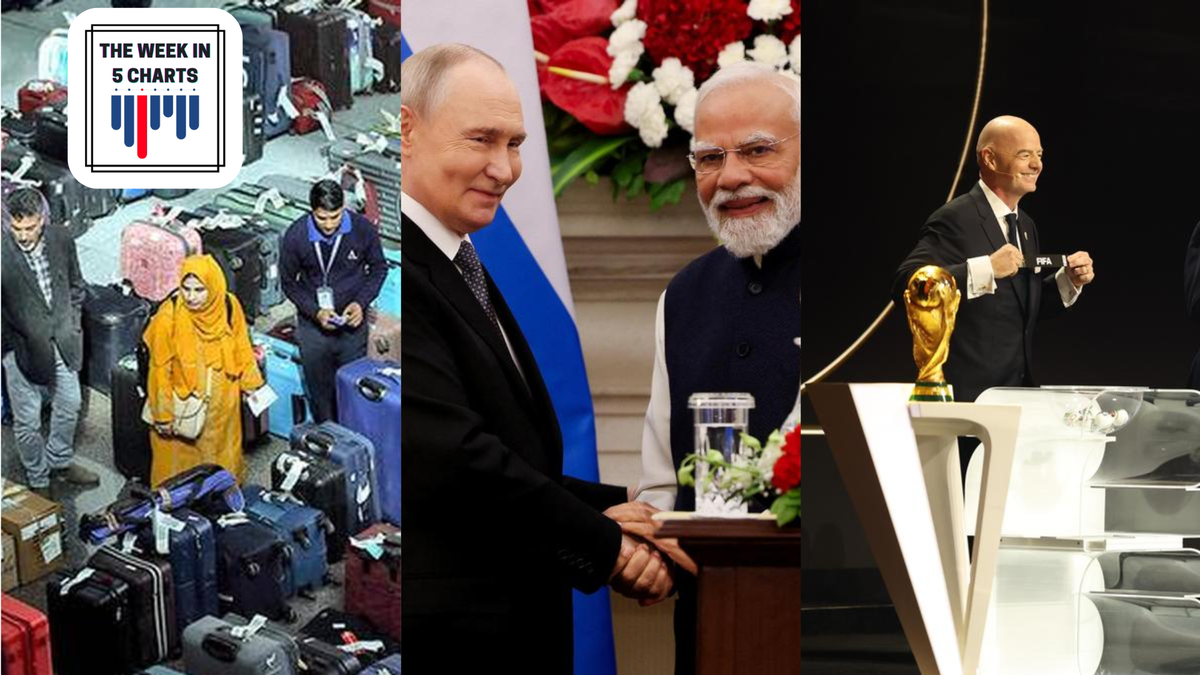
(1) IndiGo cancels over 1,000 flights, disrupting air travel
Over the last week, India’s largest airline IndiGo cancelled over a thousand flights from various Indian cities in the wake of modified norms for pilot rest and duty time. The cancellations follow an earlier round of cancellations triggered due to a required software fix to Airbus A320 aircraft.
The airline operated roughly 2,200 flights per day usually. However, this number fell after all flights from Delhi were cancelled on December 4 until midnight. Similarly, all IndiGo flights from Chennai were cancelled on December 5.
Air fares skyrocketed. For instance, direct flights from Chennai to Mumbai were priced at around ₹29,000 on December 5. Normal fares were between ₹5,000 to ₹6,000. Flights that were not cancelled were delayed. Some were delayed for over 10 to 12 hours, leaving passengers in the lurch across airports. The airline’s on-time performance plummeted.
Subsequently, the DGCA temporarily rolled back some of the revised norms, allowing six night landings instead of the revised two and defining ‘nighttime’ as 12 am to 5am again. The airline now faces a show-cause notice from the DGCA for disruptions and regulatory non-compliance, along with a possible Parliamentary Standing Committee probe.
(2) India and Russia sign trade agreements
Russian President Vladimir Putin flew to India for a bilateral talks with Prime Minister Narendra Modi on December 4, amid U.S. import tariffs on Indian goods, Russia’s war with Ukraine and U.S. criticism of India’s purchases of Russian oil.
During the visit, 16 Memorandums of Understanding were signed by India and Russia in different areas including labour migration and mobility, health and food safety, maritime co-operation and polar waters, fertilisers, customs and commerce, academic and media collaboration.
Here are some numbers that explain the changing relationship between the two countries.
India has increased its purchases of oil from Russia since the Ukraine war, responding to U.S. criticism by saying it will purchase oil from wherever it is the most advantageous in terms of national security and financial considerations.

Russia is also a prominent defence partner. It exported close to 35% of all its defence exports to India. Similarly, India sourced close to 40% of its defence imports from Russia last year.
When it comes to labour, Russia faces a shortage of workers, for which it looks to international workers. Indians received the most Russian work permits in the last four years, followed by China (2024), Vietnam (2023 and 2022) and Turkey (2021).
(3) Government app Sanchar Sathi rises privacy concerns
The government ordered the pre-installation of its anti-cybercrime application Sanchar Sathi on all smartphones on December 2, 2025 in an effort to tackle the worsening problem of cybercrime in the country. However, it reversed the order a day later following backlash from privacy advocates.
The Internet Freedom Foundation pointed to the Supreme Court judgement in 2017 (K.S. Puttaswamy) that any action intruding into privacy must meet tests of legality, proportionality and necessity. “Even if we assume legality and necessity for the limited purpose of checking the genuineness of devices, the order clearly stumbles on proportionality,” it said in an X post, pointing to alternatives that do not require system-level presence.

Pre-installed applications have elevated permissions and might not need explicit user permission for accessing some data. Here is a look at permissions that the application might require, as per information available with the Google Play app store.

A 2019 study of pre-installed apps on handsets from different vendors and their privacy concerns showed that of the six vendors analysed, three had no privacy policy shown on booting, and even then, the user had no choice but to accept if they wanted to use the device.
(4) FIFA World Cup 2026 kicks off on June 11
FIFA announced the start times for the 2026 World Cup’s 104 matches on Saturday (December 6, 2025), a day after the draw for the now 48-nation tournament which will have 12 groups of four teams each, with the tournament commencing in Mexico City on June 11, 2026. This new format – as compared to the old format of 32 nations spread out across eight groups of four teams – will now have a total of 104 matches across North America.
The World Cup opener at Mexico City on June 11 between the Mexican national team El Tri and South Africa will start at 1 p.m. local (3 p.m. EDT). Of the 104, seventy-eight games will be in the U.S., including all from the quarterfinals on, and 13 apiece in Canada and Mexico.
The new format dictates that after the group stages, the top two teams from each group (24, in total) will qualify for the round of 32, and eight best third-place finishers will also be awarded the qualification into the knockout stages.

Lionel Messi’s Argentina will begin their defence of the trophy they won in Qatar in 2022 by facing Algeria, and will also play Austria and debutants Jordan in Group J. The World Cup final will be held on July 19, 2026 in MetLife Stadium in East Rutherford, New Jersey.
(5) Key economic developments for India last week
The rupee slumped to an all-time low of 90.25 against US dollar in intra-day trade last Wednesday (December 3, 2025) before it recovered some ground to trade at 90.02. A decline in the domestic equity markets and the absence of an India-US trade deal put further pressure on the local unit, according to forex traders.

The Monetary Policy Committee (MPC) of the Reserve Bank of India (RBI) on Friday (December 5, 2025) voted unanimously to reduce the policy repo rate by 25 basis points (bps) to 5.25% with immediate effect.
The RBI’s decision comes in the backdrop of data showing India’s real Gross Domestic Product (GDP) growth accelerated to 8.2% in the second quarter and average headline inflation reduced to 1.7%, breaching the lower tolerance threshold (2%) of the inflation target (4%) set by RBI.

Published – December 08, 2025 02:49 pm IST