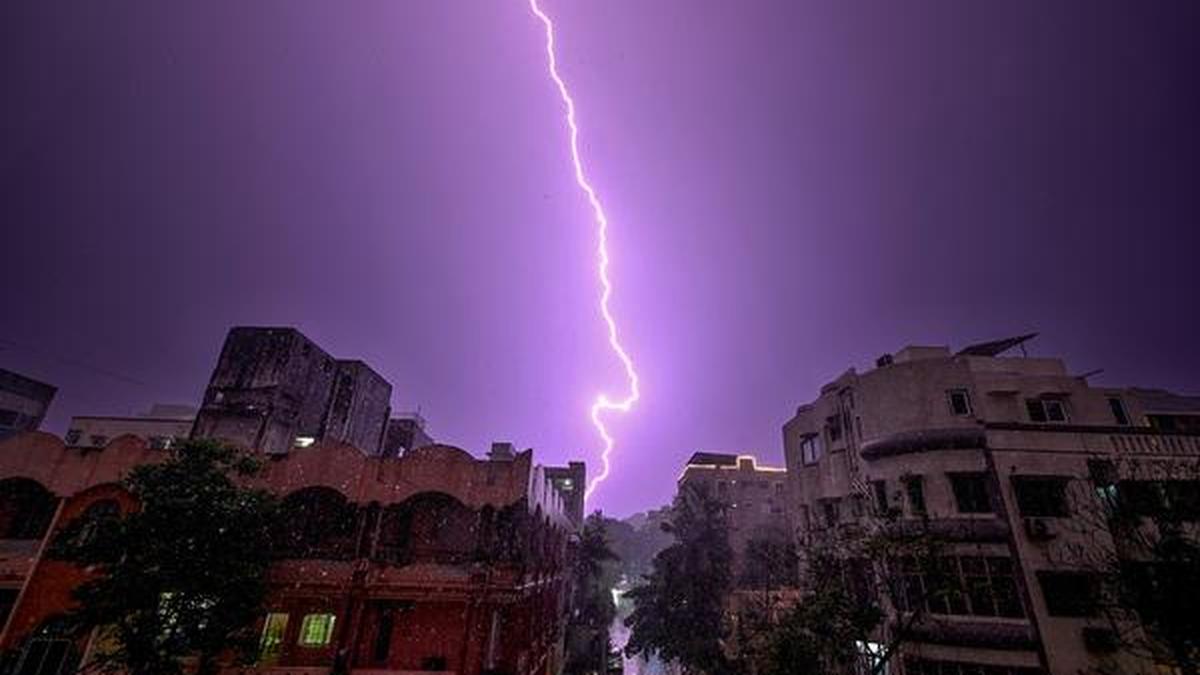
Lightning streaks across the sky over Visakhapatnam, Andhra Pradesh
| Photo Credit: KR DEEPAK
Lightning has emerged as the most lethal natural hazard in India, with the number of fatalities rising consistently over the years. A review of reports published by the National Crime Records Bureau (NCRB) showed that the country reported a total of 1,02,263 deaths due to lightning in the 50-year-period between 1975 and 2024 (Chart 1). Over half of these deaths happened between 2005 and 2024.
The decennial averages of deaths caused by lightning in the last three decades jumped from 1,683 (1995-2004) to 2,476 (2005-2014) and 2,809 (2015-2024). This is despite India’s broader progress in reducing deaths from natural causes, thanks to better forecasting, modelling and disaster preparedness. From 2016, lightning accounted for at least 50% of all deaths due to natural causes while cyclones and floods accounted for fewer (Chart 2). There were 3,315 deaths caused by lightning in 2016, which was the highest ever since 1974, as per the NCRB. In terms of proportion, lightning accounted for the highest share of all deaths due to natural causes in 2021. There were 2,880 deaths due to lightning, which was 70.4% of the 4,091 deaths due to natural causes.
The number of deaths reported due to lightning has never fallen below the 2,000 mark since 2005. The figure crossed the 2,800 mark in six of the eight years between 2017 and 2024. While there were 2,825 deaths in 2024, the latest year for which the data is available, early indications are that the number could go up in 2026. The unseasonal thunderstorm and lightning on May 13, 2026, in eastern and western Uttar Pradesh resulted in at least 111 deaths, many of which were caused by lightning.
State-wise trends show that the majority of deaths caused by lightning happened in non-peninsular States (Map 1). For instance, of the 3,315 deaths reported in 2016, nearly 60% happened in just four States — Madhya Pradesh (639), Jharkhand (542), Uttar Pradesh (384), and Odisha (376). The pattern was similar in 2024 as well. The five States of Madhya Pradesh (577), Bihar (360), Uttar Pradesh (275), Odisha (249) and Chhattisgarh (241) accounted for 60% of the 2,825 deaths reported that year (Chart 3).
A study by the Indian Institute of Tropical Meteorology (IITM), using the dataset from the Tropical Rainfall Measurement Mission’s Lightning Imaging Sensor, showed a clear increasing trend in lightning activity in India over the last two decades. The findings of the study indicated that seasonal variations showed more lightning activity over northwest India during the monsoon season, and northeast India during the pre-monsoon season. “The increase in lightning activity is due to the rise in Convective Available Potential Energy (CAPE), low-level moisture content and temperature. The increase in temperature and moisture is attributed to changes in India’s land use and land cover (LULC),” the study said. Kumar Margasahayam, an early warning systems expert, said, “This is a direct result of a warming planet where warmer air and sudden cooling is leading to more convective thunderstorms. This has led to more and frequent thunderstorms and more lightning phenomena.”
The India Meteorological Department currently provides thunderstorm forecasts, while the IITM provides real-time alerts on lightning through its mobile application Damini. The app also shares precautionary guidelines during thunderstorms in 23 regional languages, making safety information more accessible. The increasing fatalities emphasise the need for creating more awareness among the public on precautions to be taken during lightning attacks.
Published – May 27, 2026 08:00 am IST