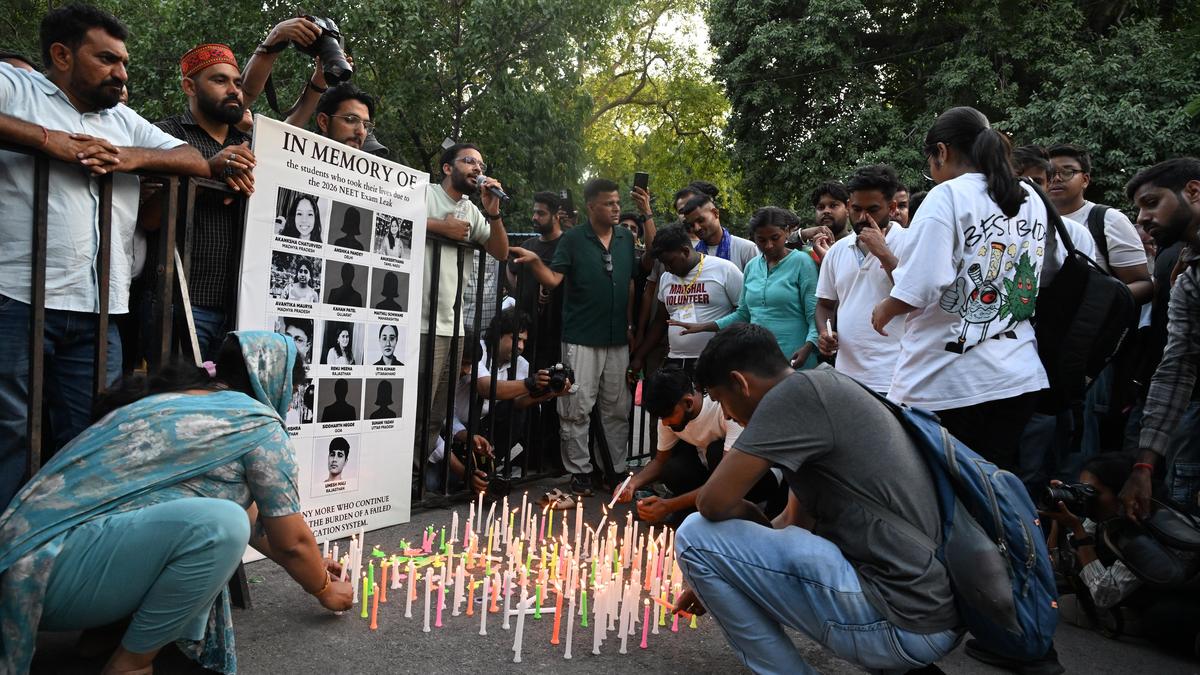
Supporters lighting candles to pay homage to students who Committed Suicide during the third day of Protest against Education Minister Dharmendra Pradhan by Cockroach Janta Party, at Jantar Mantar in New Delhi on June 22, 2026
| Photo Credit: SHUBHOMOY SIKDAR
The sustained protests led by the Cockroach Janta Party (CJP) demanding accountability over paper leaks in the National Eligibility-cum-Entrance Test (NEET) came to an end on Saturday with the government accepting many of their demands, including the resignation of Union Minister of Education Dharmendra Pradhan, compensation for the families of the deceased who ended their lives over the NEET paper leaks, and the withdrawal of criminal cases against protesters.
Thousands of protesters who gathered across many places in the country despite crackdown by the government, including brutal police action in Delhi on July 20, have termed Mr. Pradhan’s resignation a ‘historic win’. While their demands have successfully pinned accountability for a leaked question paper, larger questions around high-stakes entrance exams — the NEET in particular — such as the proliferation of coaching centres, increased expenditure for families, and high levels of stress experienced by students, remain unaddressed.
Over 20 lakh students appeared for NEET in the first week of May. Reports indicate that more than a dozen students died by suicide after the exam was cancelled and rescheduled due to widespread allegations of question papers getting leaked. These suicides cannot be seen in isolation. The number of student suicides increased by about 80% from 8,068 in 2014 to 14,488 in 2024, the latest year for which the Accidental Deaths and Suicides in India (ADSI) report by the National Crime Records Bureau (NCRB) has been published.
Over 1.23 lakh students ended their lives between 2014 and 2024 in the country.
The Ministry of Education stated in Parliament that suicides among students are driven by various causes such as academic stress, family problems, mental health issues, financial distress and interpersonal conflicts. The ADSI reports capture “failure in examination” as a distinct category of reason for suicides. Suicides for which “failure in examination” was the primary reason accounted for 21%, or more than one-fifth, of the total number of student suicides between 2014 and 2024.
Over 2,000 students died every year due to failure in examinations, with 2021 being the only exception. Cumulatively, over 25,000 students died by suicide due to failure in exams between 2014 and 2024, of which 55% were under 18 years and another 42% between 18 and 30 years of age.
Though student suicides cannot be seen in the context of NEET alone, this highly competitive medical entrance exam has come to symbolise these systemic issues. The exam has repeatedly come under focus for issues such as paper leaks, inhumane levels of checking of students while entering exam halls, and concerns over unusually high-scoring patterns from select centres. Over 15 lakh students have appeared for the NEET examination every year since 2015. However, those who made it to the pool of qualified candidates is less than 57%
Moreover, the need to join private coaching and the reality that many have to repeat the exam after studying for another year or two to qualify have contributed to significant costs for households.
More than 35% of secondary and higher secondary students end up going for private coaching. In fact, households’ private coaching expenses is about a third of their entire education expenditure.
While the protests have come to an end, at least temporarily, these systemic problems await closure.
The data for the charts were sourced from the National Testing Agency’s press releases, the Accidental Deaths and Suicides in India (ADSI) reports, and Comprehensive Modular survey: Education 2025
With inputs from Gauri Singavarapu, Gandla Sneha, and Sachin Swaraj who are interning with The Hindu Data Team
Published – July 27, 2026 08:00 am IST