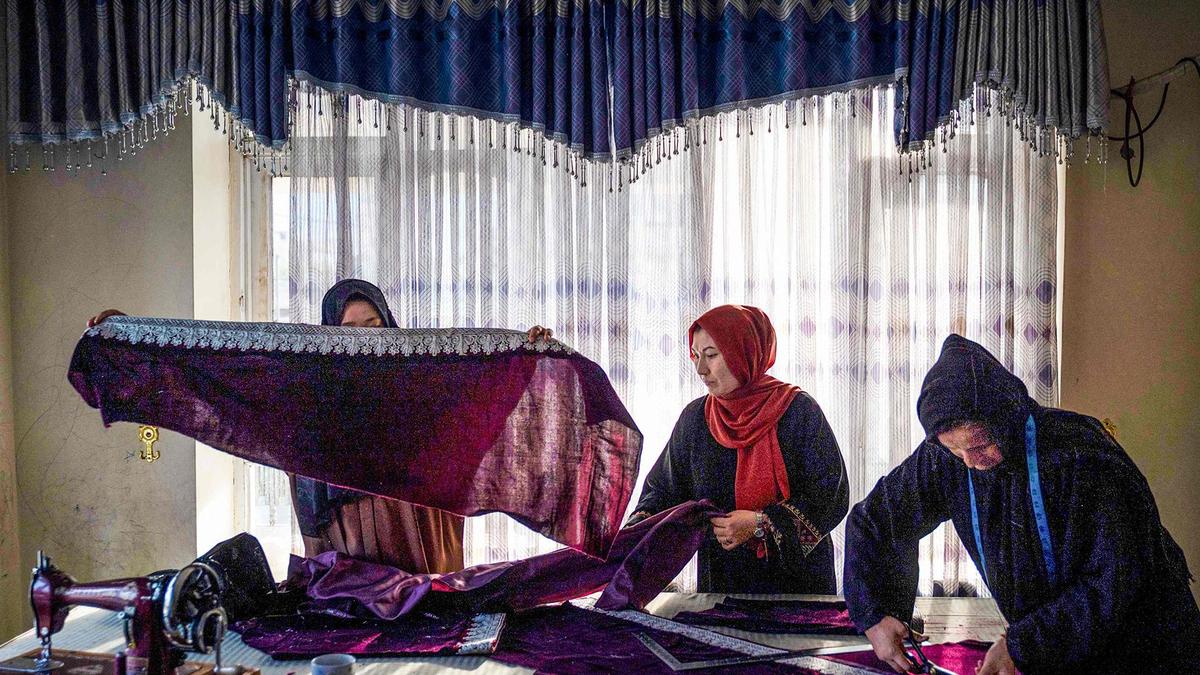
The Taliban’s draconian restrictions over the past five years have led to Afghan women facing an unprecedented rollback of rights and freedoms. As universities and many formal workplaces become inaccessible, growing numbers of women are turning to small-scale entrepreneurship as one of the few remaining avenues to earn a livelihood and retain a measure of economic independence.
According to World Bank and ILO estimates, female labour-force participation declined from 14.6% in 2021 to 5.2% in 2022 and stood at approximately 5.1% in 2024 and 2025. Male participation, by contrast, remained close to 70%.
Data from Afghanistan’s National Statistics and Information Authority shows the scale of the exclusion. In 2019, Afghan universities enrolled 54,861 female students. By 2023-24, that number had fallen to just 102, and by 2024-25 no female students were recorded in universities at all. Female admissions followed a similar trajectory, dropping from 16,496 new entrants in 2019 to zero in both 2023-24 and 2024-25. Female graduates also disappeared from the system, falling from 9,937 in 2019 to 67 in 2023-24 and none in 2024-25.
Male enrolment also declined over the same period. UNICEF and UNESCO have attributed the deterioration in educational outcomes to a combination of restrictive policies, chronic underinvestment, recurring humanitarian crisis, weak infrastructure, widespread learning poverty and teacher shortages.
These figures reflect the impact of Taliban policies that have barred women and girls from secondary and higher education, effectively shutting down the pipeline that once produced female lawyers, engineers, doctors, professors and civil servants. Additionally, more than 80% of female media workers lost their jobs when the Taliban returned to power.
As opportunities in education and formal employment narrowed, many women turned to businesses. Data cited by the Afghan Women’s Chamber of Commerce and Industry indicates that registered women owned businesses increased from 2,421 before the restrictions to 9,162 afterward, while estimates of informal women owned enterprises rose from 52,000 to 120,000.
Manufacturing (43%), services (30%) and trade (19%) were the largest sectors, including tailoring, handicrafts, carpet weaving and food processing. Beauty salons, which once employed 60,000 people, were banned by the Taliban.
As Afghanistan grapples with economic challenges and international isolation, Taliban officials have framed support for women-led businesses as part of a broader push for economic self-sufficiency. In a Reuters interview, acting commerce minister Haji Nooruddin Azizi said, “We always support women investors” and “We will support any item which can help us for self-sufficiency.”

While the number of women owned enterprises has grown, a 2024 UNDP survey of 3,122 women led small and medium enterprises across 18 provinces offers a snapshot of the challenges faced by women entrepreneurs in an increasingly restrictive economic environment.
Only 28% were formally registered and licensed, while 64% operated without registration or licences. An additional 7% were unsure of their registration status and 2% did not disclose it.
The lack of formal registration limits access to markets, finance and opportunities for growth. The strain is evident in the fact that 41% women entrepreneurs reported being in debt. However, only 5% had obtained loans from formal banks. Because to secure loan from a bank, you need to have a business background, a recommendation letter from the AWCCI and property documents which many Afghan women lack. So they primarily rely on family networks, friends and personal savings to fund their businesses.
Nearly one-third of respondents also cited gender discrimination as an obstacle to market access, while earlier interviews found that mobility restrictions, including requirements for a male guardian in some situations, have posed significant challenges.
As universities close their doors to women and labourforce participation remains among the lowest in the world, small businesses have become an economic lifeline for thousands of Afghan women seeking income.
Published – June 25, 2026 07:00 am IST