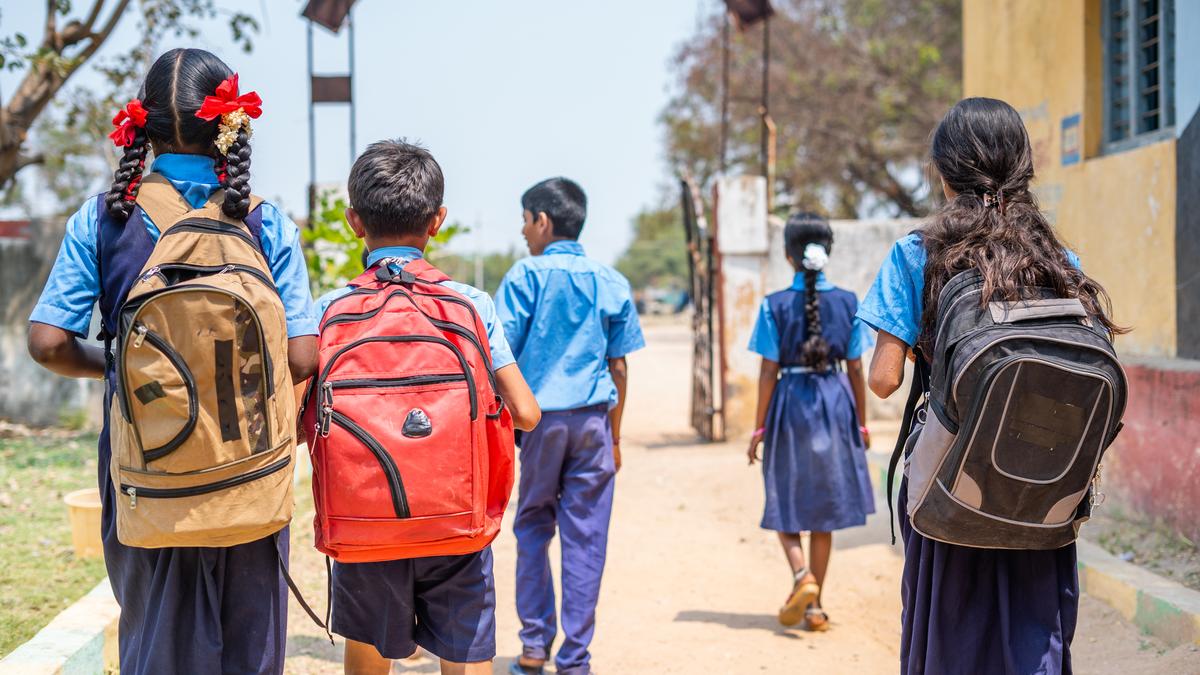
India’s ability to ride the cresting wave of the demographic dividend, before it recedes, depends critically on the education and employment choices of its 367 million young people. While surveys track such outcomes regularly, little is known about how close outcomes are to initial goals. The State of Working India Report 2026 published by Azim Premji University offers insights into youth aspirations and attainments.
The study utilises the Population Council’s dataset — UDAYA: Understanding the Lives of Adolescents and Young Adults — which surveyed adolescents in Uttar Pradesh and Bihar, the two Indian States with the largest youth populations. The sample of interest covers girls and boys aged 15-19 when first contacted in 2015-16 and tracks them three years later in 2018-19 when they were 18-22 years old. Of the full sample of 13,141 youngsters surveyed, aspirations were recorded only for 6,300 who were enrolled in education at the time of the survey.
To begin with, at ages 15-19 when the 6,300 youngsters were first contacted, about 72% aimed for at least graduate education. Three years later, this share grew to 84%. Moreover, aspiration levels were similar across gender, religion, and caste. Uniformly high educational aspirations across social groups indicate a convergence of aspiration windows, possibly due to economic progress and rapid expansion in access to the internet and social media.
Educational attainments, in contrast, showed that not all dreams come true. In the duration between the two interviews, years of schooling completed grew by only 1-2 years on average instead of the expected three years. In making progress towards their educational goals, over half the sample fell short, on average by 1.7 years.
About 11% of the sample had already exited education to begin with. Between the two interviews, another 40% exited formal education. While some may naturally exit on completing desired education, the average number of years of education attained at exit is only 8 years.
It is striking that while aspirations across wealth quintiles are not very different, attainments diverge sharply. Those in the poorest wealth quintile are more likely to fall short of their goals compared to those in the richest quintile. While the share of boys falling below their educational goals hovers between 50% and 60% across wealth quintiles, there is noticeable variation for girls — from 66% in the poorest to 38% in the richest quintile.
Over half the sample discontinues education before completing Class 12; this group is disproportionately composed of married girls. Married girls face greater barriers than their unmarried counterparts, even amongst the richest group. In fact, girls who remained unmarried by the time of the second interview (18-22 age group) were as ambitious as boys at setting goals and were more effective at meeting them.
In general, girls and boys have different reasons to discontinue education. Boys leave to join the labour market while girls exit at the time of marriage. Failure or disinterest and costs of education are some gender-neutral contributing factors.
Quality of education
A more troubling picture emerges when learning levels are examined. UDAYA employs tools designed by the Annual Status of Education Report (ASER) for students aged 5-16 to measure proficiency in reading and math. UDAYA respondents were well beyond this age and would be expected to achieve the highest levels of proficiency in both dimensions.
However, at age 15-19 when respondents were likely engaged in schooling, 70% of unmarried girls and boys could read a Class 2-level story against only 45% of married girls. The modest gender gap favouring unmarried girls in goal attainment disappears when it comes to learning levels. Worse still, the share of those who could perform three-digit by one-digit division correctly was just over half for boys, 35% for unmarried girls and only 15% for married girls.
Policy takeaways
The uncomfortable question this raises is: are some groups aspiring for education beyond their reach?
Regular data collection on aspirations and attainments over time at a national level will help track both youth goals and whether public infrastructure is helping individuals achieve them. This two-State study shows that aspirations are already high, but attainments have not kept pace across all groups. It is worth confirming whether this is a country-wide pattern and focusing policy attention on removing structural barriers to access.
Education programs often default to exposing students to high-achieving role models ostensibly to inspire. While well-intentioned, simply raising aspirations with no realistic pathway to achieving them is short-sighted. These programs need to be supplemented with support for identifying interests, goal-setting, and skill-building. Stronger linkages between education institutions and employers can provide prospective graduates with a more accurate picture of the labour market and facilitate a smoother transition into the workforce. Better-quality education will strengthen the effectiveness of these programs.
While it is tempting to only look at the motivational aspects of goals, consistent failure to achieve targets can cause frustration, which in turn may lead to lower effort and worse life outcomes. Keeping track of youth aspirations against the system’s ability to match them is critical if we are serious about creating a motivated and productive labour force for the future.
Note: Reading levels include recognition of letters, ability to read words, ability to read a short paragraph (Class 1 level text), and ability to read a longer ‘story’ (Class 2 level text). Math levels are recognition of single-digit numbers (1–9), recognition of double-digit numbers (11–99), and ability to perform a two-digit subtraction sum with borrowing and a three-digit by one digit division sum. Children above Class 3 (older than 8 years) should be able to perform division based on NCERT textbook curriculum.
Garima Agarwal is an Assistant Professor of Economics at Azim Premji University, Bangalore. The views expressed are personal.
Published – May 13, 2026 07:00 am IST