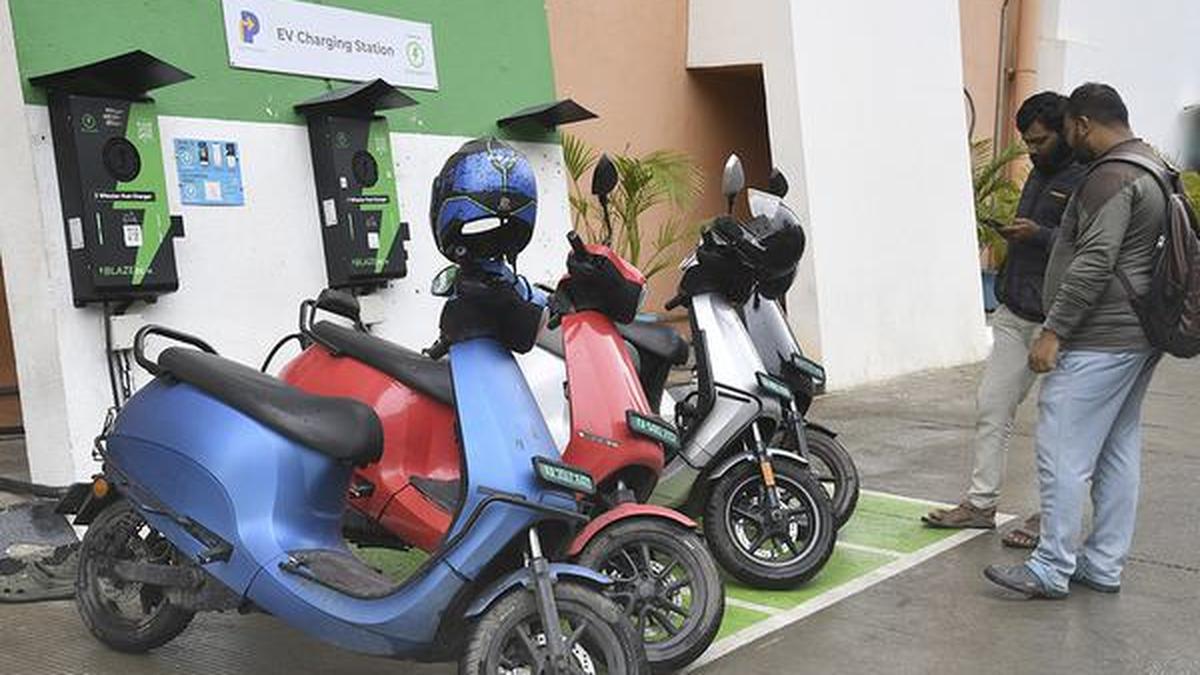
Low voltage: An electric vehicle charging station at Freedom Park in Bengaluru.
| Photo Credit: ALLEN EGENUSE J
The surge in global oil prices after the U.S.-Iran war has exposed the differing levels of energy vulnerability in Asia’s two largest economies, India and China. Since the conflict began on February 28, crude and refined fuel prices have increased rapidly, with the Organization of the Petroleum Exporting Countries (OPEC) basket price rising by about 67% between February 27 and March 27, pushing up petrol, diesel and LPG costs.
The rise in fuel costs has revived interest in alternatives such as Electric Vehicles (EVs), plug-in hybrids and electric two-wheelers, especially in countries that rely heavily on imported oil.
The war has also increased the risk of supply disruptions due to the closure of the Strait of Hormuz, through which about one-fifth of global oil supply normally passes. China received 5.4 million barrels of crude oil per day via the Strait in FY25Q1, the highest in volume. India followed at 2.1 million barrels per day. But while both countries depend on imported oil, China’s faster adoption of EVs has reduced its transport sector’s exposure to fuel shocks, whereas India’s transport sector remains heavily reliant on fossil fuels.
Data on EV penetration show the scale of the gap between the two countries. In March 2026 alone, new-energy vehicles accounted for about 52.9% of passenger car sales in China, according to estimates by the China Passenger Car Association, while in India, EVs made up only about 6% of new car registrations in 2026.
Absolute sales numbers highlight the contrast. China sold about nine lakh new-energy passenger vehicles in March 2026 alone, whereas India registered about 72,000 electric cars in the last three months. In the two- and three-wheeler segment, China sold more than 72 lakh electric vehicles in 2024, while India’s sales even in 2026 were only about 4.27 lakh.
Because China began electrification earlier, the total number of EVs in use is far larger. China’s electric car fleet had reached about 2.3 crore by 2024, compared with about 3.96 lakh in India in 2026. China had about 6.8 crore electric two- and three-wheelers in use, while India has about 23 lakh. Overall, India’s total EV stock stood at about 27.3 lakh, still far below China’s levels.
Infrastructure and supply chains also reflect the gap. As of February 2026, India has about 14 electric cars per public charger, compared with roughly nine in China by the end of 2025, indicating higher charging availability which has allowed China to push EV adoption faster in the passenger vehicle segment.
These differences have direct implications during oil crises. Countries with high EV adoption are less exposed to sudden increases in petrol and diesel prices because a larger share of transport runs on electricity.
The recent increases in fuel price across several Asian countries following the Iran conflict have strengthened the argument for accelerating the transition to electric mobility. The shift is already visible in the market. Bloomberg recently reported that demand for EVs has increased across Asia after the Iran oil shock, with Chinese carmakers such as BYD seeing higher showroom traffic as consumers shift away from fossil fuel-driven vehicles.
India has made progress, especially in electric two-wheelers, but adoption in cars remains low and charging infrastructure limited, compared to China. As long as petrol, diesel and LPG remain the backbone of transport, every geopolitical conflict in West Asia will continue to be felt directly in Indian households.
Published – March 31, 2026 07:00 am IST