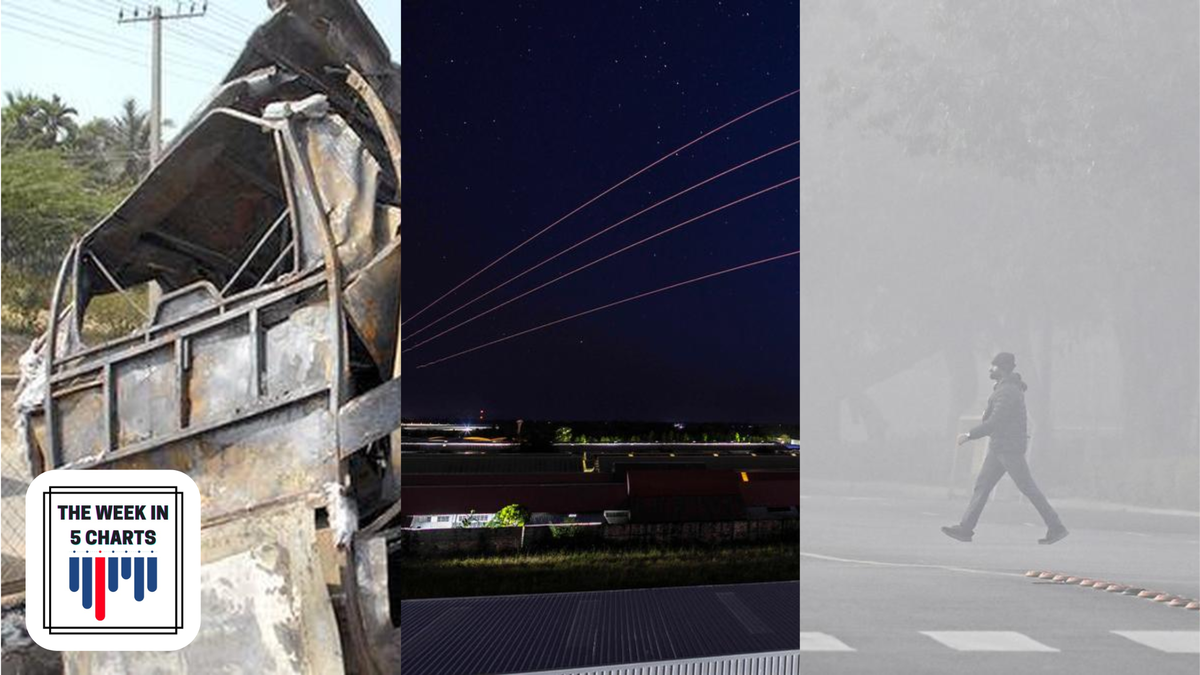
(1) Bus accident kills 7 near Hiriyur, Karnataka
Seven people were killed after a container truck rammed into the Gokarna-bound bus from Bengaluru, triggering a fire that rapidly engulfed the vehicle and left passengers with little time to escape.
The tragedy has once again caused concerns that have surfaced repeatedly after similar accidents in recent years, particularly those involving fire. In October, a Bengaluru-bound private sleeper bus caught fire following an accident in Kurnool district of Andhra Pradesh, claiming 19 lives. The scale of fatalities in such incidents has underlined the unique risks posed by sleeper coaches, where passengers are often lying down in confined spaces and evacuation can be slow and chaotic.
Industry representatives acknowledge that sleeper buses, while popular, come with inherent safety challenges. Speaking to The Hindu, Nataraj Sharma, president of the Karnataka Private Bus Owners’ Association, said, “Sleeper buses are relatively uncommon globally and are used extensively only in India.”
(2) Delhi air pollution becomes severe
Delhi’s air quality worsened to the ‘very poor’ category on Friday last week (December 26, 2025) after being in the ‘poor’ category for two days prior. On December 23, the government announced the lifting of GRAP 4, wherein restrictions were imposed on certain activities like construction and conduct of school classes. GRAP 1, 2 and 3 curbs remained in place.
In December, Delhi recorded air quality of ‘severe’ for three days, with December 14 AQI being the lowest at 461.
Through November and this month, people have come out in protest against the government’s handling of the city’s recurring air pollution problem. In November, a group of 50 to 60 people protested near the India Gate for more than two hours. Later, on December 3, over a hundred protesters assembled at Jantar Mantar calling for a discussion of the issue in the Parliament.
Delhi faces chronic pollution issues due to a mix of factors like low temperatures and low wind speeds during the winter months, along with pollution from stubble burning and vehicular emissions. Low temperatures and wind speeds combine to form smog. This smog stays suspended near the surface for a longer time due to low temperatures, trapping pollutants from rising upward, and sometimes causing flight delays and cancellations.
(3) Thailand and Cambodia agree to ceasefire
Thailand and Cambodia agreed to a ceasefire on Saturday last week (December 27, 2025) after border clashes over boundary disputes in May this year. This ceasefire follows an earlier U.S-brokered agreement between the countries to cease fire in October. This fell through in December.
The border between the two countries was drawn by France in 1907, which had colonised the region. A committee was formed in 2000 to peacefully address overlapping claims, but no significant progress was made. In 2003, a Thai celebrity questioned Cambodia’s authority over one of the temples along the border, igniting protests and the torching of the Thai embassy.
Last year, a joint government plan with Cambodia for utilising offshore energy resources set off concerns that Thai island territory might be lost to Cambodia. In May this year, Cambodia had approached the International Court of Justice on clarification of which country owned the land around an iconic temple near the border. The death of a Thai soldier in the same month brought tensions to a head. At least 101 people had been killed after weeks of conflict, Reuters reports say.
(4) U.S. strikes terror targets in Nigeria
The U.S. struck Islamic State militants in northwest Nigeria at the request of Nigeria’s government on Thursday last week (December 25, 2025) after concerns voiced by the country’s president Donald Trump about the targeting of Christians by terrorists in the country.
Nigeria has acknowledged the menace of terrorists within its borders, but said that there is no clear religious distinction that these terrorists make when choosing their targets. The Armed Conflict Location and Event Data Project (ACLED) said in a 2022 release that while attacks targeting Christians have risen, so had overall attacks that year.
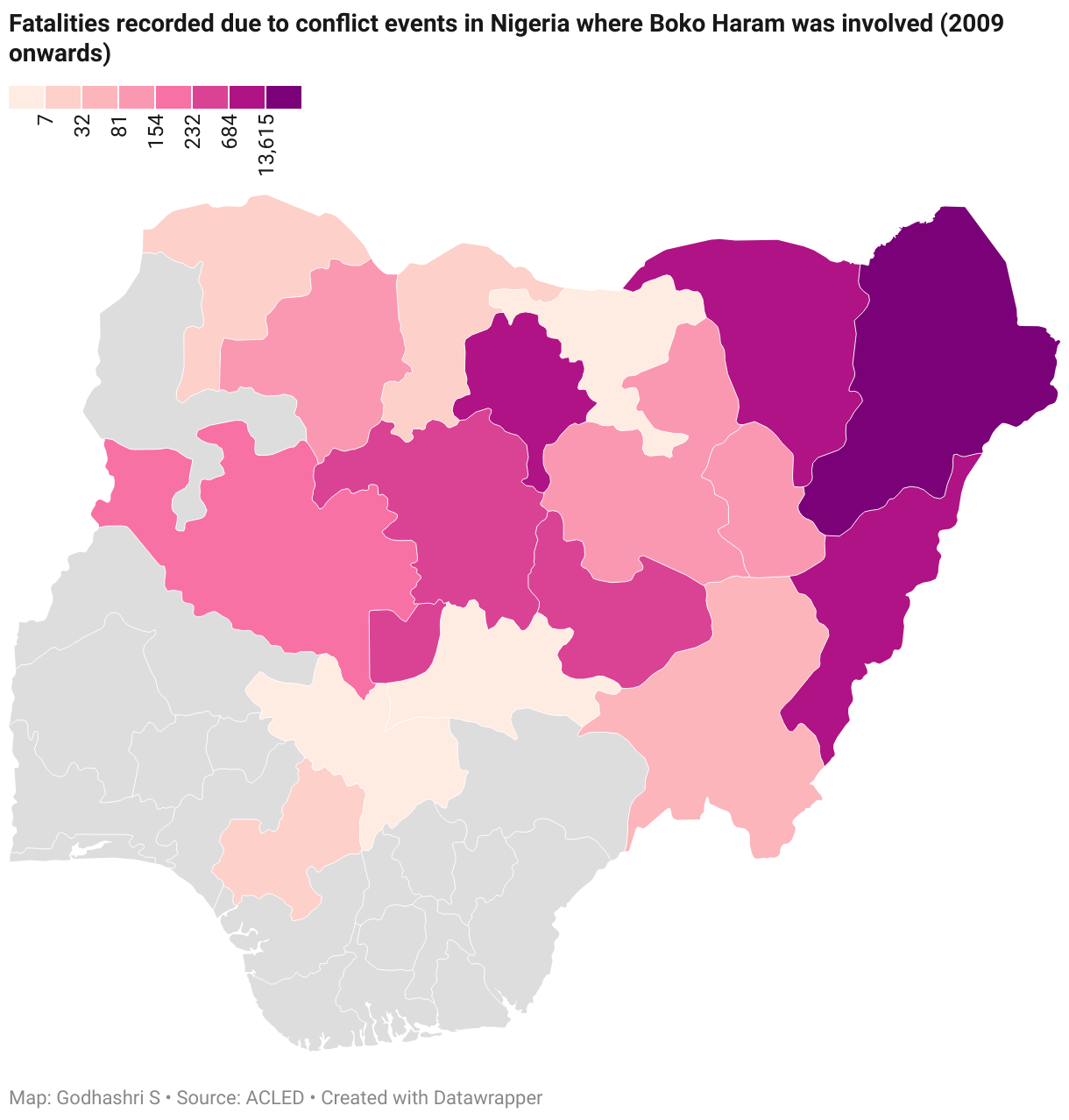
Here is a look at the extent of violence perpetrated by Boko Haram and associated terror outfits in the country since 2009.
Boko Haram, which is one of the country’s biggest terror outfits, has targeted mostly the northern parts of the country, with a bigger Muslim population and fewer Christians compared to the South.
While targeted attacks do happen where churches are burnt and Christians are kidnapped or murdered, deaths happen due to a variety of reasons. Christian deaths can also be caused due to conflicts in resource control.
A National Statistics Bureau report from Nigeria in 2018 pointed out that as the Boko Haram insurgency spread, herders lost their land and were forced to move more South. This resulted in conflict between herders and farmers. While the herders were mostly made of Fulani Muslims, the ethno-religious divide became exacerbated, with counter-attacks increasing violence between the communities.
(5) Myanmar junta stages election after five years of civil war
Voters trickled to Myanmar’s heavily restricted polls on Sunday last week (December 28, 2025), with the ruling junta touting the exercise as a return to democracy five years after it ousted the last elected government and triggered a civil war.
Former civilian leader Aung San Suu Kyi remains jailed, while her hugely popular party has been dissolved and was not taking part.
Campaigners, Western diplomats and the United Nations’ rights chief have all condemned the phased month-long vote, citing a ballot stacked with military allies and a stark crackdown on dissent.
The pro-military Union Solidarity and Development Party is widely expected to emerge as the largest bloc, in what critics say would be a rebranding of martial rule.
The Southeast Asian nation of around 50 million people is riven by civil war and there will be no voting in areas controlled by rebel factions that have risen up to challenge military rule.
Published – December 29, 2025 04:23 pm IST