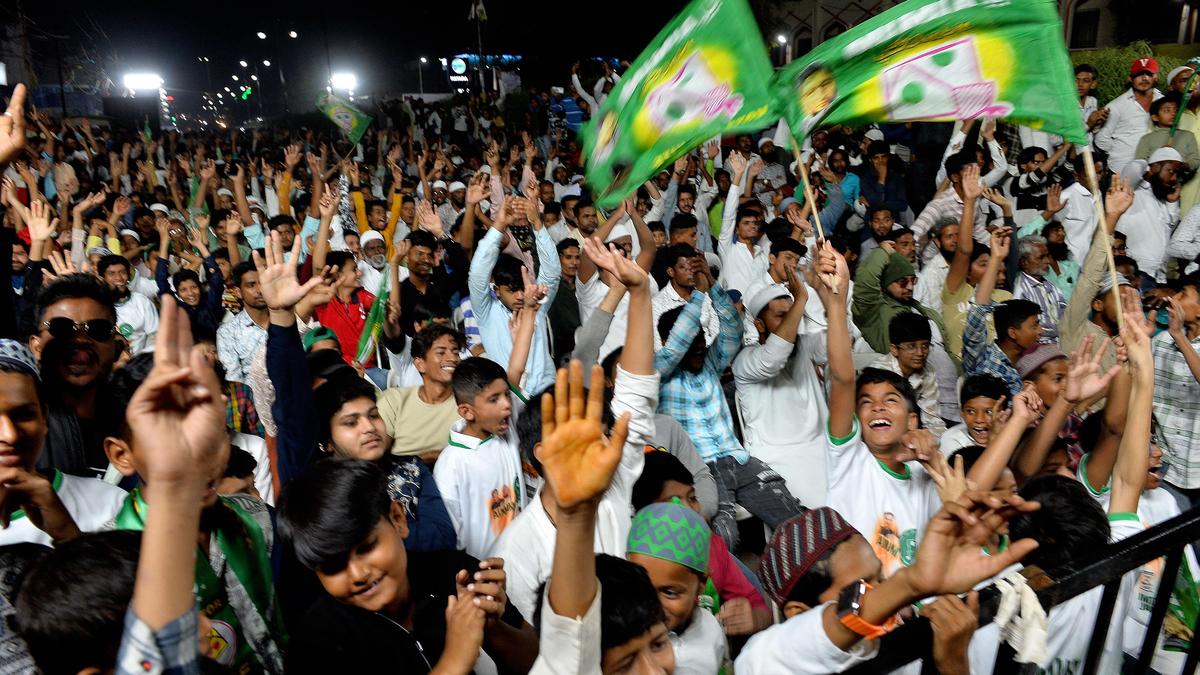
Public during Asaduddin Owaisi, President of AIMIM’s election rally in Aurangabad, Maharashtra on Friday November 15, 2024
| Photo Credit: VIJAY SONEJI
The 2020 Bihar Assembly election proved to be a close contest between the BJP-led National Democratic Alliance (NDA) and the RJD-led Mahagatbandhan (MGB). One key factor behind the MGB falling short of the majority mark was the spoiler effect created by Asaduddin Owaisi’s All India Majlis-e-Ittehadul Muslimeen (AIMIM).
The party won five seats in the 2020 polls, all in constituencies with a relatively higher Muslim population in Bihar. Although AIMIM secured only 1.3% of the State’s votes, the support was concentrated. For instance, in 2020, AIMIM and its allies secured less than 0.5% of the votes each in seats with less than 25% and 25-40% Muslim populations, winning no seats in such constituencies. In contrast, the alliance secured 27.2% of votes in seats with more than 40% Muslim population, winning 5 out of 8 seats contested in such constituencies.
The chart below shows the vote share (in %) and seats by AIMIM and its partners in seats with varying Muslim populations in Bihar
To identify constituencies with higher Muslim populations, The Hindu Data Team adopted the following approach. Its earlier analysis of the Special Intensive Revision (SIR) of electoral rolls showed that there was no disproportionate deletion of Muslim voters in the State. In other words, the share of Muslims in the total population and their share among deleted electors were broadly similar across all seats. Consequently, if the share of deleted Muslim voters in a constituency was relatively higher, it indicated a higher concentration of Muslim population there. This measure was therefore used as a proxy to identify Muslim-predominant seats.
The map below shows the share of Muslims among deleted electors in a constituency in the SIR. The categories include constituencies with less than 25% deleted Muslim electors, 25-40% deletions, and more than 40% deleted Muslim electors
AIMIM and its current alliance partners are once again following a targeted approach in 2025, with party fielding candidates in 28 seats, mostly in the Seemanchal region (eastern Bihar, where the Muslim population is significant. However, much has changed since the 2020 polls. Several of the party’s former candidates and MLAs have switched sides, with some now contesting from seats offered by rival parties in 2025. Table 3 lists select examples of such political realignments.
Within two years of the elections, four of the five MLAs had joined the RJD. Only one of them, Shahnawaz, is contesting the 2025 elections from an RJD seat. The fifth MLA, Akhtarul Iman, who also serves as AIMIM’s Bihar State president, has remained with the party and is contesting again. At least two candidates who lost in 2020 have also switched sides, one of whom is contesting from a Congress seat.
The table below shows the list of political realignments of select AIMIM candidates since the last election in 2020
Moreover, the alliance forged by AIMIM in 2020 proved short-lived. This time, the party with a new coalition. AIMIM is aiming to replicate its 2020 performance by tapping into discontent within Muslim communities, particularly in areas where they constitute a significant population. In fact, a comparison of vote shares and strike rates by the alliances in 2020 and 2015 reveals the significant impact made by AIMIM.
For example, in constituencies with over 40% Muslim population, the MGB’s vote share increased from 26% in 2015 to 36% in 2020. During the same period, AIMIM and its partners boosted their vote share from 5.2% to 27.3%, while the NDA’s share declined from around 39.8% to 22%.
The chart below shows the vote share (in %) secured by different alliances in constituencies with over 40% Muslim population
Despite this gain in vote share, the MGB’s strike rate dropped from 62.5% in 2015 to 33.3% in 2020 in these constituencies. Conversely, AIMIM and its partners improved their strike rate from 0% to 62.5%. The NDA saw a decline in strike rate from 50% to 12.5%.
The chart below shows the strike rates (in %) secured by different alliances in constituencies with over 40% Muslim population
Figures arrived at using present alliances and past electoral data.
With inputs from Areena Arora
Published – November 07, 2025 08:00 am IST